Showing posts with label Comparison. Show all posts

Thursday, 4 February 2016

A Complete History Of My Sexual Failures and Undefeated compare and contrast


“Undefeated is a 2011 documentary directed by Daniel Lindsay and T.J. Martin. The film documents the struggles of a high school football team, the Manassas Tigers of Memphis, as they attempt a winning season after years of losses. The team is turned around by coach Bill Courtney, who helps form a group of young men into an academic and athletic team.”

“A Complete History of My Sexual Failures is a 2008 British documentary film directed by Chris Waitt who also starred as the main character and composed some of the music.”

Both of these films are documentary’s but they are very different types of documentary. Firstly, Undefeated is an Ethnological documentary which is a type of documentary that looks in the lives and culture of a particular group in a scientific or in this case an analytical fashion. On the other hand, A Complete History Of My Sexual Failures is a Mockumentary which Is a fiction film that uses a documentary form to suggest it’s a documentary but is often comical. It is also perhaps a documentary reconstruction because it is based on true events but not all of it. I was able to tell that some parts of the documentary were scripted for example when he took 7 Viagra pills (which is not healthy) and still managed to run around the city asking people to have sex with him.


A complete History is also a very different documentary because it uses interactive mode. This enables the ‘star’ to interact and almost converse with its audience. It would also be considered a personal and authored documentary.

Undefeated however is not so scripted and therefore rules out using interactive mode, but some characters do interact with the camera person in an interview style. As they do it A Complete History. Instead they use observational mode where they simply record things happening in front of the camera in long takes until they have what they need.

Undefeated is a much more realistic documentary. We are directly shown at the beginning the surroundings they live in. Run-down empty streets with poorly built houses. In the film we are shown a contrast between the football players houses and the coach’s neighborhood. The coach’s neighborhood is an attractive one, with big houses and clean streets. This shows us immediately the class difference between the two groups. A Complete History does not give us an establishing shot of the area he lives in. So we couldn’t make the same contrast between class of him and his girlfriends.


I think both documentaries were good. A Complete History due to is comical side made me want to keep watching and undefeated was uplifting throughout. Undefeated however was my preferred film and it gave a lot of inspirational messages to the audience such as when the coach Bill Courtney said “The character of a man is not measured in how he handles his wins, but what he does with his failures."

Monday, 30 November 2015

Mediterranea and Rust and Bone Comparison


Mediterranea by Jonas Capignano. Poster.  Semaine de la Critique.: Movie Posters, Jonas Capignano, Of The, Week


Mediterranea is a 2015 Drama film written and directed by Jonas Carpignano. It follows two men and their dangerous journey travelling from Africa to Italy for a better life. It focuses on the hostility they go through as refugees travelling from country to country and the life and death situations they are faced with.  

Rust and Bone is a 2012 French Drama and Romance film written and directed by Jacques Audiard. Alain leaves Belgium for Antibes to live with his sister and her husband after he is put in charge of his young, helpless son. Alain soon bond’s with killer whale trainer Stephanie, but their bond strengthens after Stephanie suffers from a tragic accident.

In both the films the protagonists share a similar goal. To make their families happy. In Mediterranea Ayiva wants to please his daughter and give her the things she needs and wants. All he strives to do by travelling to Italy is to earn. Alain has the same goal. Although this goal is not obvious during the start of the film by the end this goal is obvious and Alain shows his true feelings towards his son, which is that he ends up healthy and happy.


One theme that is shown in both is escapism. In Mediterranea the film focuses predominantly on escapism as the protagonists Ayiva and Abas are ‘escaping’ Africa in search of a better life for their families. By working in Europe they not only want to escape the harsh reality of poor living in Africa but they also want their families to escape the struggles of living in Africa by sending gifts and money back from Europe in order to give their families the lives they deserve. In Rust and Bone both protagonists are also attempting to escape something in their lives. Alain tries to escape his feelings by competing in bare knuckle fights but he also tries to escape his son. Alain isn’t portrayed as the most caring father and is constantly trying to find excuses to get away from his son, but we eventually see his fatherly nature shine through when he must save his son. The other protagonist Stephanie on the other hand is trying to escape something very different. After a traumatic event, Stephanie loses her legs from below the knees. She tries to escape the feeling of worthlessness. Stephanie wants to continue her life as normal but at times is shown to start to give up.  She also escapes judgement of seeing someone disabled, she does this by being brave and doing things such as being carried into the sea to swim.

Our themes for A2 film are power, poverty and conflict all of which are used in the films which makes them both useful and potential case studies. Mediterranea has a strong theme of power. The power is shown through race. The black people who have come to Italy are the minority and the white people are the majority. In one dramatic and traumatising scene Abas gets beaten up, nearly killed by a group of white men. They have ultimate power in this scene, to be able to determine whether someone lives and dies is an example of too much power being given to someone.


Poverty is also used in this film and is evident from the very start, to have to move countries in order to give something to your family is an obvious sign of high poverty. This is still going on in the world today, people move countries in search of a better life due to the poverty and desperation that is evolving. Poverty is also used in Rust and Bone, which we can see from just looking at their living arrangement. Alain and his son now live in a small house with Alain’s sister and her husband and outside in their back garden is where they keep their animals is tiny penned cages in horrible conditions. Also Alain takes part in bare knuckle fighting to make money which can be devastating for his health.


Overall both films were evident of our main themes and included other themes also. I enjoyed them both as they both told very different stories but followed their struggles to show how life is very difficult for people. They also represent different mediums. For example Rust and Bone represents disability and Mediterranea represents race. 

Thursday, 1 October 2015

La Haine and City Of God comparison


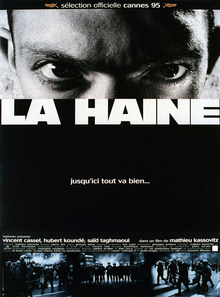
In this piece I will be comparing La Haine a 1995 film directed and co-edited by Mathieu Kassovitz and City of god a 2002 film directed by Fernando Meirelles and Katia Lund. I will be discussing themes and the similarities and differences between how they are portrayed.

One main theme discussed in both films is police brutality. Both of these films show how different races are treated by the police by they are shown in very different ways. In La Haine the police are shown to be against different races as it is set in Paris, France which is predominantly a white area. With the three protagonists in La Haine being of different ethnicity’s; Jewish, Arab and Black it is shown how they struggle to live with their lives whilst constantly having the police on their backs watching what they do. The theme of police brutality vs race is more evident in other films like La Haine such as Spike Lee’s 1989 Do The Right Thing.


This theme is also shown within City Of God however because it’s set in Rio, Brazil the police brutality doesn’t surround race but it more so surrounds class. The film is set in the poorer areas of Brazil where the easiest way to make money is through crime, the protagonist in this is poor and lives his life surrounded by others thieving and selling drugs in order to make a living. This is shown when Li’l Ze is walking with his gang and has a shootout with the police. The police constantly keep watch on the town because of this but don’t take much time to find out who has really done right or wrong. I think the police brutality is La Haine follows a more serious issue because of the discrimination of race that still links to the murders that are happening in the world today. Class is still shown in La Haine however on particular scene this is evident is when the three protagonists Vinz, Hubert and Said are sitting in a children’s playground are a news reporter and her cameraman come to talk to the boys about the riots that previously happened. Rather than joining them in the playground they simply look over the railings in the “pit” the park sits in showing the power and dominance the reporter has over the boys, it’s almost as if she’s looking in to an animal pen at a zoo.

Another theme that occurs in both films that links to police brutality is pride. In both films the characters they follow do not want to lose their pride and give in to the police.  In La Haine Vinz is the character who portrays pride, his pride is firstly described by a metaphor when and old man tells them a story in the toilets. The man goes on to tell a story about one of his friends Grunwalski. The Grunwalski story mimics our characters. In their situation they "miss the train" when (SPOILER) - Vinz gets shot, Grunwalski continuously reaches for the train but cannot reach because he tries to maintain his pride and keep his trousers up. The hand represents Vinz's quest for racial equality and an end to police brutality but he cannot reach them because he won't let go of his pride and co-operate with the police. In City Of God however Li’l Ze is trying to keep his pride by staying the “top dog” in the drug business by destroying all his competitors and still escaping from the police. He tries to keep his pride and reputation by not letting his competitors get away.


 The theme of masculinity also falls into this struggle for pride and reputation. This theme is mostly recognisable in City Of God because all the men in the drug business want to be the best and climb their way to the top defeating all competitors. Masculinity is incredibly evident when a young boy goes for help hoping he can help him get revenge for his father as he says “Kid? I smoke, I snort. I’ve killed and robbed. I’m a man” this conveys how committing crimes is all the young children see and think it’s the right thing to do if you want to grow up and become something better; a man. Rocket the centre protagonist also wants to show his masculinity through losing his virginity as if you become a man after having sexual relations. Masculinity is also a theme in La Haine but is not so frequent the main person who wants to be seen as masculine is Vinz who thinks he’s tough and brave after getting a gun, two both very stereotypical traits of becoming a man. 


Sunday, 22 March 2015

Spike Lee vs Quentin Tarantino

Spike Lee


Who is he?
Shelton Jackson "Spike" Lee (born March 20, 1957) is an American film director, producer, writer, and actor. His production company, 40 Acres and a Mule Filmworks, has produced over 35 films since 1983.

Where is he from?
He was born in Atlanta, Georgia. His mother Jacqueline Carroll was a teacher of arts and black literature and his father, William James Edward Lee III was a jazz musician and a composer. When he was a child the family moved to Brooklyn, New York. During his childhood his mother nicknamed him "Spike". 

Where did he train?
Lee enrolled in Morehouse College, a historically black college, where he made his first student film, Last Hustle in Brooklyn. He took film courses at Clark Atlanta University and graduated with a BA in Mass Communication from Morehouse. He did graduate work at New York University's Tisch School of the Arts, where he earned a Master of Fine Arts in Film & Television. Lee's thesis film, Joe's Bed-Stuy Barbershop: We Cut Heads, was the first student film to be showcased in Lincoln Center's New Directors New Films Festival.
In 1985, Lee began work on his first feature film, She's Gotta Have It. With a budget of $175,000, he shot the film in two weeks. When the film was released in 1986, it grossed over $7,000,000 at the U.S. box office

Spike Lee is considered an Autuer. Lee's movies have examined race relationscolorism in the black community, the role of media in contemporary life, urban crime and poverty, and other political issues. Lee has received two Academy Award nominations and won numerous other awards, including an Emmy Award as well as the 2013 Gish Prize "for his brilliance and unwavering courage in using film to challenge conventional thinking.
Awards?
 Berlin International Film Festival 1997 - Get On The Bus - Honourable Mention
 Black Reel Awards 2001 - Love And Basketball - Best Film                      
American Black Film Festival 2004 - Time Warner Innovator Award              
Black Movie Awards 2006 - Inside Man - Best Director                                 
Black Reel Awards 2011 - If God Is Willing And Da Creek Don't Rise - Best Television  Documentary

He has won a total of 39 awards and has had a further 59 nominations. 
Controversy?
In 2012 Spike Lee spoke about his intention to never watch Django Unchained. He elaborated on his dissatisfaction on Twitter, writing, "American Slavery Was Not A Sergio Leone Spaghetti Western. It Was A Holocaust. My Ancestors Are Slaves. Stolen From Africa. I Will Honor Them." 

Quentin Tarantino 

                                                                            
Who is he?                                                                                                                                  
Quentin Jerome Tarantino (born March 27, 1963) is an American film director, screenwriter, cinematographer, producer, and actor. Tarantino grew up an obsessed film fan and worked at Video Archives, a video rental store while training to act. His career began in the late 1980s, when he wrote and directed My Best Friend's Birthday, the screenplay of which formed the basis for True Romance

Where is he from?
Tarantino was born in Knoxville, Tennessee in 1963. He is the son of actor and amateur musician Tony Tarantino and nurse Connie McHugh. Tarantino's father, from Queens, New York, is of Italian descent, while his mother has Irish and Cherokee ancestry. When he was four years old, they moved to Torrance, California and later to the Harbor City neighborhood of Los Angeles.

Where did he train?
Tarantino did attend James Best Acting School but soon grew bored and left after two years. He then landed a job which threatened to interfere with his long-term acting ambitions. As an employee of Video Archives, a now-defunct video rental store in Manhattan Beach, he and fellow movie enthusiasts (including Roger Avary) discussed cinema and customer video recommendations at length. He paid close attention to the types of films people liked to rent and has cited that experience as inspiration for his directorial career. Tarantino has been quoted as saying: "When people ask me if I went to film school I tell them 'no, I went to films.'"
Awards?
Golden Globes 1995 – Pulp Fiction – Best Screenplay Motion Picture
Csapnivalo Awards 2000 – Jackie Brown – Best Screenplay
American Choreography Award 2004 – Kill Bill – Outstanding achievement in Choreography
Austin Film Critics Association 2009 – Inglorious Basterds – Best original screenplay             
Oscars 2013 – Django Unchained – Best writing & Original Screenplay  


Tarantino had won 122 awards and been nominated for a further 103.
Controversy? 
Spike Lee questioned Tarantino's use of racial epithets in his films, particularly the word "nigger". In a Variety interview discussing Jackie Brown, Lee said, "I'm not against the word...And some people speak that way. But Quentin is infatuated with that word. What does he want to be made–an honorary black man?" Tarantino responded on Charlie Rose by stating:
"As a writer, I demand the right to write any character in the world that I want to write. I demand the right to be them, I demand the right to think them and I demand the right to tell the truth as I see they are, all right? And to say that I can't do that because I'm white, but the Hughes brothers can do that because they're black, that is racist. That is the heart of racism, all right. And I do not accept that ... That is how a segment of the black community that lives in Compton, lives in Inglewood, where Jackie Brown takes place, that lives in Carson, that is how they talk. I'm telling the truth. It would not be questioned if I was black, and I resent the question because I'm white. I have the right to tell the truth. I do not have the right to lie."

Wednesday, 18 March 2015

Comparison between Inglorious Basterds and Miracle at St. anna

Throughout this piece I will be writing a comparison. Inglorious Basterds is the first film i will be comparing. It is a 2008 War film written and directed by Quentin Tarantino  starring Brad Pitt, Christoph Waltz, Melanie Laurent, Michael Fassbender, Eli Roth (Co-Director) and Diane Kruger. The film I will compare it too is Miracle at St. Anna which is a 2008 war film written and directed by Spike Lee, starring Derek Luke, Laz Alonso, Omar Benson Miller, Michael Ealy, Valentina cervi and Pierfrancesco Favino.


The first comparison is between the genres; both films are in the war genre and both are set following the events in WWII. However Inglorious Basterds is set in France during the war and follows a group of U.S Jewish Soldiers that plan to assassinate Nazi Leaders, it also follows a Jewish Cinema owner who had a past encounter with one of the leaders and plans to also assassinate the leaders. Where as Miracle at St. Anna is set primarily in Italy during the war and follows a group of four Buffalo Soldiers of the 92nd Infantry division who seek refuge in a town and bond with some of the town locals.


Both films are set around the same time yet get across different two very different points of view, the Jewish pov and the Black soldiers pov. The films are similar in that in both films the Nazi's are the obstacles that stop them from from reaching their goals and both films relate because they show the issues either religion or race had during the war. On the other hand Inglorious Basterds showed the issues between both religion and race because the lady who owned the cinema hired a black man and he was treated with no respect by any of the Nazi's. Miracle at St. Anna also produces war in a different sense. It shows the war between the Buffalo Soldiers and the American Army Generals.

Both films feature soldiers as their protagonists and they are all shown to be close, their relationships tend to seem more familial than friendly, like they have been together a long time and although they are at war and should be trying to protect one another in both films they seem more like they are protecting family. I think this familial relationship especially stands out in Miracle at St. Anna, and is portrayed even further when they find the young boy. In Miracle at St. Anna they all seem to work together and all have a say in what they will do where as in Inglorious Basterds Lt. Aldo Raine is the leader.


Inglorious Basterds predominantly follows a linear narrative, however their is a time skip from 1941 to 1944. Miracle at St. Anna on the other hand follows a non linear narrative because it is usually set during the war which in context of the film is the past and is shown in flashbacks. Miracle at St. Anna  could follow a circular narrative because Hector Negron who is introduced to us and questioned at the beginning is also the man that is shown at the end. A particular object that is found during the start of the film is also shown to us again at the end.

I feel that in both films the characters are developed however they are developed more in Inglorious Basterds, especially Shosanna who owns the cinema. I feel she was the most developed because we learnt about her back story which as the very first sequence of the film. However for me the characters in Miracle at St. Anna were easier to connect to because their plan was not to deliberately harm anyone but because of the situation they were in they had too. Sam Train was the easiest character to connect to because Lee made his character caring and at times relate able. Both directors produced the relationships between the characters really well.


In my opinion I preferred Inglorious Basterds because the narrative was easier to follow and the film was more exciting but  narrative in Miracle at St. Anna was stronger. However I think both films successfully showed the War genre in very different ways and were able to represent war in it's true self because neither tried to make it seem calmer or not as bad than it was.

Tuesday, 30 September 2014

Soft vs Wasp comparison


Soft and wasp are both short films. Soft was written and directed by Simon Ellis about a father and his son who are terrorised by the same gang and are forced to face confrontation. Whereas Wasp was written and directed by Andrea Arnold and is about struggles a young single mum goes through with many young children. Both of these films are in the genre of Drama.

During the film soft a gang of youths are shown using a handheld camera, throughout this the camera is shaking and is slightly out of focus which shows that it is bad quality which may be portraying the quality of life that these teenagers. Where as in the same film another teenager is shown with his dad and the camera is stable and focused. This is showing the difference between the lifestyles of these two groups of people. Only the handheld camera effect is also used during the film wasp which would be used because you can tell that the main family in the film are living in poverty and do not have a very good lifestyle so by the camera being unstable it lets you know their life is also unstable.

The theme of family is the one of the main themes shown in both. In each film the theme of family is shown to be important and a necessity. Both families in each are looking out for each other and they show a close bond. Conflict is also a theme portrayed throughout both films. In soft the conflict is used to show a division in social status with the father and son being a higher class which contrasts with the status of the teenagers. However in wasp the conflict is used to show how a mother would protect her child when somebody else causes her children harm.

In the film Soft the father and son are shown to be locked away with no escape when they are trapped in their house with the teenagers hanging around outside, they feel in danger and uncomfortable during this scene. But in wasp the mother finds her freedom when she finally gets to go out with a man who she has feelings for. This is a major contrast as it shows the change in situations. At the start of soft the father and son feel they have freedom however when the teenagers are outside they feel they have lost this privilege. This is the complete opposite to Wasp because the lady gains her independence as the film develops and looses her sense of entrapment.

I enjoyed both these films because they explore similar themes that occur in everyday life. This makes it easier to sympathise with the characters and connect with both of the films as a whole.